Tuesday, July 16, 2024

Data Modelling and Analysis with Excel’s Power Pivot

An Excel worksheet is limited to 1,048,576 rows and beyond this you cannot add new data. However, Power Pivot provides a high-performance environment where you can work with large datasets (beyond the 1M rows limit)  and create simple or complex calculations. It allows you to create data models and establish relationships between different data sets.

Power Pivot is an Excel COM add-in. By default, it is disabled. To enable it; 

  1. Go to File > Options > Add-Ins.
  2. In the Manage box, click COM Add-ins> Go.
  3. Check the Microsoft Office Power Pivot box, and then click OK. If you have other versions of the Power Pivot add-in installed, those versions are also listed in the COM Add-ins list. Be sure to select the Power Pivot add-in for Excel.

Once enabled, a Power Pivot tab will be added to the ribbon.

1 Power Pivot Tab

Watch the video below to see how you can load data into Power Pivot using Power Query.

Building Relationships in Power Pivot

Power Pivot allows you to create relationships between tables with at least one common variable/column. This allows you to create a complete report that filters through all your data. There are 2 types of relationships that you can create in Power Pivot.

  1. One-to-One (1:1) Relationship – In this kind of relationship, each row in one table is linked to only one row in another table. This is mostly used when you want to store additional details about a specific record/entity. For example, you can have a single table of supplier names and another table with those supplier names, their contacts, and addresses.
  2. One-to-Many (1:*) Relationship – In this kind of relationship, each row in one table can be linked to many rows in another table. This is the most common type of relationship. For example, on the one side, you can have a table of your SKU items, and the on the many side, you can have a table of related purchase records.

There is another type of relationship, Many-to-Many (*:*), where many rows related to many rows in another table. However, Excel does not directly support this relationship but you can create it using a junction/associative table so that the two “many” tables are linked to the same “one” table. For example, assume you have a budget table for your item categories for each month, and another table containing purchase orders for items in these categories for each month. If you would like to know whether your purchase orders are within the budget, you would create a relationship between the item category column in the budget table and the PO table. However, because there are multiple entries of a single item category in each table, this would be a many-to-many (*:*) type of relationship and is not supported. To relate the two tables, you would have to create a dimension table that contains only unique item categories to act as the junction table. Then both your Budget table and PO table would relate to the Item Categories table via a one-to-many (1:*) relationship. With the two tables linked in this way, your Item Categories slicer should originate from the Item Categories table so that you can filter both PO table and Budget table at the same time.
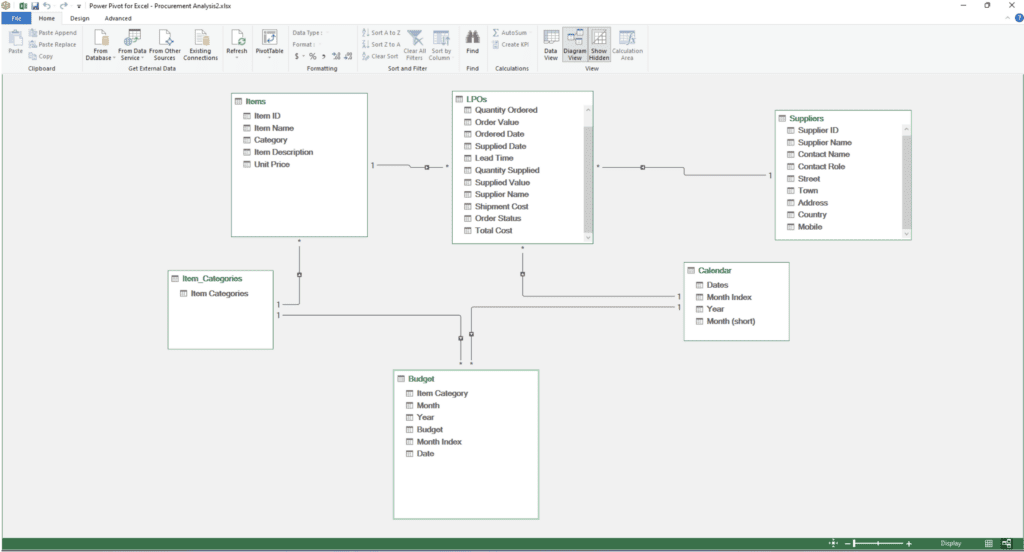
2 Data Model in Power Pivot

Creating a Calendar for your Data

One more thing to consider when creating a data model is having a dedicated “Dates Table”. If your data has a date range of 3 years, and you have a FACT table that contains all the dates within this range, you can use it as a date table. However, if none of your FACT tables contain all the dates within this range, you should create a dedicated dates table. This is necessary because if you have a table that contains dates not present in another related table, or it contains multiple entries for a single date, you cannot create a single date filter/slicer. To be able to view all your date within the context of the same date period(s) you would need a dimension dates table containing all the dates (unique dates) in your data. You would then create a one-to-one(1:1) or one-to-many(1:*) kind relationship between this table and all the tables in your data containing a date column. 

To learn more about creating relationships and creating a data model, watch the video tutorial below.

https://youtu.be/yTMsBPMYovo

Looking for project-driven supply chain management software?

Current SCM is the first of its kind – supply chain management software purpose-built to support the most complex procurement and materials management projects. With materials management and vendor document requirements uniquely integrated into the order, Current SCM provides a unified, collaborative platform to streamline the end-to-end process of project-driven procurement and materials management.

If you are engaged in any direct procurement, technical procurement, project procurement or third-party procurement, Current SCM will improve your procurement and materials management workflow. If you are engaged in all four, Current SCM will revolutionize the way you do business.

Contact our sales professionals at Current SCM today!


source https://www.vistaprojects.com/data-modelling-and-analysis-with-excels-power-pivot/

source https://vistaprojects2.blogspot.com/2024/07/data-modelling-and-analysis-with-excels.html

Getting Data with Excel Power Query

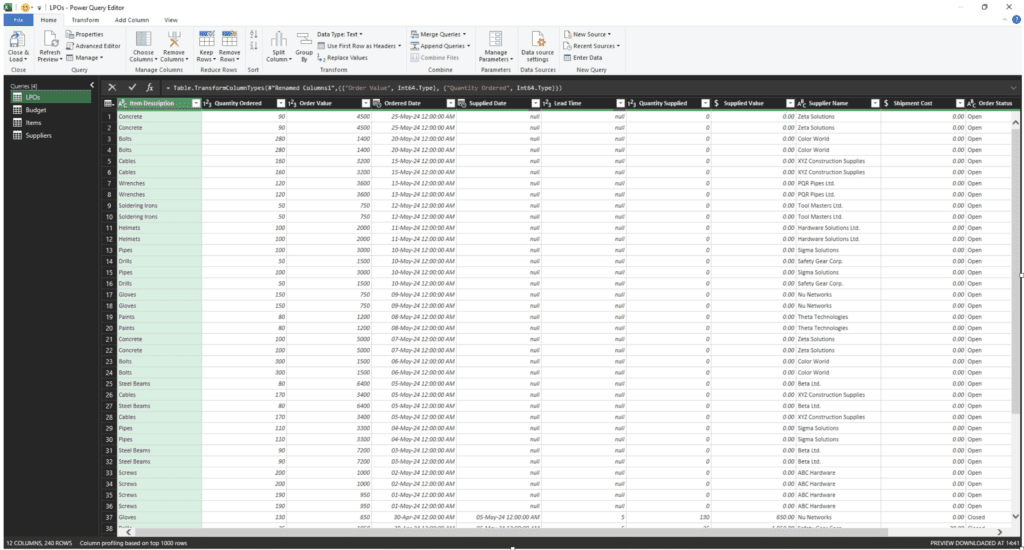
Copying and pasting data can be a quick and easy way to get data into Excel. However, not all data sources and data types will suit this method. If the data does not have a clearly defined structure that suits a spreadsheet, copy-pasting might be a tedious and needless task. The Excel Power Query module allows for an easier and cleaner way of getting and preparing your data for analysis. It allows you to clean and transform your data into a usable format before importing it into Excel. It also allows you to get data from different locations and file types. You can import data from an existing database, PDF files, CSV files, Text files, and other Excel workbooks.

There are four phases to using Power Query.

  1. Connect:- Make connections to data in the cloud, on a service, or in your local machine.
  2. Transform:- Shape data to meet your needs
  3. Combine:- Join data from different sources to have a unified dataset
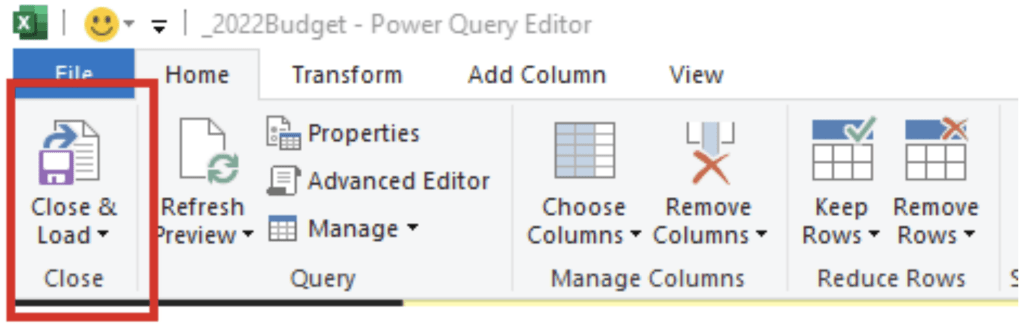
  4. Load:- Complete your query and load it into a worksheet or Data model with periodic refreshes.
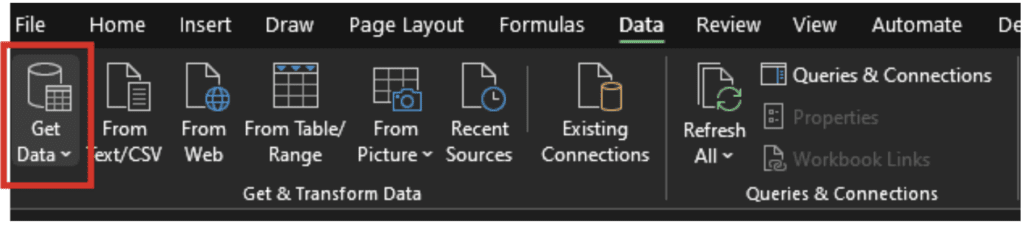
1 Getting Data Using Power Query
2 Loading Data from Power Query

Cleaning and Transforming data with Excel Power Query

Power query has many features that allow you to transform and clean data. It considers the most common unstructured data types and provides the tools needed to transform the data. For example, you can use the “Unpivot Columns” button in the Transform tab to change horizontally spread data into a vertical table which is desirable for analysis. Power Query records each data manipulation/transformation step and stores it in its memory. Each time you refresh your data, the same steps get applied to maintain the format. That means you only need to transform the data once.

Note: Any transformation done with Power Query does not affect the original data. 

You can also add columns and virtual tables from your data inside Power Query. This allows you to create summary columns like months and years from a dates column. You can also append different tables with the same information to only have one table or merge overlapping datasets into one.

When transforming your data, you want to organize it in a way that is easy to access, search, and analyze. A simple way to do this is by ensuring a single row provides all the information for a single record. For example, if you have purchase records for items over some dates arranged in rows and columns, one row should only show information about the purchase of a single item. That is, the item name, quantity of purchase, date of purchase, and purchase amount. Likewise, no two columns should be of the same data type. That is, instead of having 12 columns for each month showing the purchase amount, create a single column for all the months and a second column for the purchase amount. This is what is considered a good data structure.

Watch the video below to see how you can transform some of the most common unstructured data formats to a structured format for analysis.

Looking for project-driven supply chain management software?

Current SCM is the first of its kind – supply chain management software purpose-built to support the most complex procurement and materials management projects. With materials management and vendor document requirements uniquely integrated into the order, Current SCM provides a unified, collaborative platform to streamline the end-to-end process of project-driven procurement and materials management.

If you are engaged in any direct procurement, technical procurement, project procurement or third-party procurement, Current SCM will improve your procurement and materials management workflow. If you are engaged in all four, Current SCM will revolutionize the way you do business.

Contact our sales professionals at Current SCM today!


source https://www.vistaprojects.com/getting-data-with-excel-power-query/

source https://vistaprojects2.blogspot.com/2024/07/getting-data-with-excel-power-query.html

Data Analysis and Visualization using Microsoft Excel

Our Data Analysis and Visualization using Excel tutorial is designed to get you acquainted and comfortable using Excel to create analytic solutions that can be used across your organization or for your own projects. You will become familiar with the Power Pivot Excel add-in that lets you work with large datasets, create relationships between different datasets or tables, and use Pivot Tables and Pivot Charts analyse your data. You will also familiarize yourself with dashboard design and data story-telling techniques that will enable you to create eye-catching reports and enable your report viewers to quickly draw insights and make decisions.

Data analytics play a crucial role in decision making processes, performance evaluations, cost reduction & efficiency strategies, gaining insight & understanding market trends, risk management, innovation, quality control, and more. Successful companies have learnt to leverage the power of data through analytics to make better data-driven decisions, optimize processes, and stay competitive in a dynamic business environment.

What you need to get started

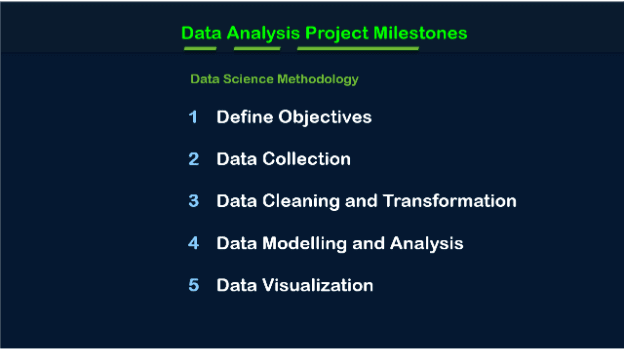
Data Analytics is both art and science. It requires some technical skills, analytical thinking, and creative problem solving. To ensure accuracy and reliability in the analytical solution you create, you will need to follow a process that aligns with established protocols in data collection, cleaning, and processing. The list below highlights the key steps/milestones you need to complete when working on a Data Analytics project, also referred to as The Data Science Methodology.

  1. Define Objectives – This is the start of all data analytic projects. You want to establish the need for analytics. Determine what business questions need answers by engaging the business stakeholders. These include business owners, IT admins, managers, and those who need the analytics solution. You also define what kind of data you need at this stage.
  2. Data Collection – After establishing the questions that need answered, and the type of data you need, establish ways of collecting the data if the data does not exist.
  3. Data Cleaning and Transformation – If your data exists, you might need to prepare it for analysis. This stage involves structuring and refining your data so that it is in a format that can be used for analysis. Much of the time in a data analytics project is spent at this stage.
  4. Data Modelling and Analysis – After cleaning and transforming your data, it is now ready for analysis. Modelling involves establishing connections between different data sources/tables and creating measures and calculations that combine values from different tables. Modelling ensures that all relevant data is “connected” for a complete analysis.
  5. Data Visualization – After analyzing your data, you will need to show your results in such a way that it is understandable, easy to read, and user friendly. This involves using visual representations of your data such as charts, graphs, maps, etc. The choice of visuals to use depends on the data you want to display and the level of expertise of your audience.
1 Data Science Methodology

Watch the video below to learn more about data science methodology and the features that make Excel a good data analytic tool.

Looking for project-driven supply chain management software?

Current SCM is the first of its kind – supply chain management software purpose-built to support the most complex procurement and materials management projects. With materials management and vendor document requirements uniquely integrated into the order, Current SCM provides a unified, collaborative platform to streamline the end-to-end process of project-driven procurement and materials management.

If you are engaged in any direct procurement, technical procurement, project procurement or third-party procurement, Current SCM will improve your procurement and materials management workflow. If you are engaged in all four, Current SCM will revolutionize the way you do business.

Contact our sales professionals at Current SCM today!


source https://www.vistaprojects.com/data-analysis-and-visualization-using-microsoft-excel/

source https://vistaprojects2.blogspot.com/2024/07/data-analysis-and-visualization-using.html

Tuesday, May 14, 2024

Is quality supply chain management really that important when constructing energy facilities?

The energy sector will rapidly evolve over the next few years, reflecting ongoing innovation, private capital market investment, and the critical need to address global climate change.

Demand for clean energy is expected to skyrocket as energy sector leaders in Canada and the U.S. work toward climate targets of cutting emissions up to 40-50% by 2030, with the hope of establishing an emissions-free power sector by 2035, and achieving net zero emissions economy-wide by 2050.

The importance of quality supply chain management in energy facility construction in North America cannot be overstated. Efficient supply chain management ensures that energy facilities are constructed on time, within the set budget, and meet the highest quality standards.

Role of Supply Chain Management in Energy Facilities Construction

When we refer to energy facility construction, we are talking about the planning, design, and physical implementation, as well as infrastructure specially dedicated to producing, extracting, and generating energy.

These facilities include a wide range of technologies and sources of renewable energy, hydrogen and nuclear power. Some examples include power plants (coal, natural gas, nuclear, solar, wind, and hydroelectric), refineries, and oil and gas extraction facilities.

The construction of energy facilities goes through numerous stages, from site selection and design to the actual building and commissioning of the facility.

Given how complex and sensitive energy production can be, it requires specialized knowledge and expertise in engineering, environmental concerns, and regulatory compliance.

The Importance of Supply Chain Management in Energy Facilities Construction

quality supply chain in the energy industry

The construction of energy facilities is essential for the energy sector, as it directly affects the amount and efficiency of energy generation and the overall energy infrastructure of a region or a country.

But the supply chain is what helps energy facilities get up and running. Let’s explore how: 

1. Timely Completion of Projects

One of the main goals is to finish projects on time. Supply chain management helps by making sure materials and equipment arrive when needed. This coordination with suppliers and others prevents delays during construction.

2. Controlling Associated Construction Costs 

Controlling costs is also a big focus. Good supply chain management helps save money by improving how materials are bought, negotiating good deals with suppliers, and avoiding unnecessary waste.

3. Quality Assurance of Construction Materials

Maintaining high quality is a must in energy facility construction. Supply chain management ensures that all materials and components meet the required standards through thorough inspections.

4. Manage Associated Risks 

Managing risks is essential when working with the construction of energy facilities. Supply chain management helps identify and deal with potential issues like supply chain disruptions or unexpected market changes.

5. Seamless Collaboration

Collaboration among everyone involved, from subcontractors to suppliers, is made more accessible through supply chain management. This teamwork ensures that everyone is working toward the same project goals.

Improving Supply Chain Management for Energy Facility Construction

Here’s how to improve supply chain management for energy facility construction:

1. Encourage Collaboration Among Teams

Avoid making the mistake of placing all supply chain responsibilities on one person, often only one procurement officer. Instead, form a highly-skilled procurement team and promote collaboration as a critical part of efficient supply chains.

To increase teamwork, you should also ensure communication is clear among everyone involved, from project managers to external partners.

2. Use the Just-in-Time Inventory System to Avoid Stockups and Delays

Streamline the construction process by focusing on just-in-time delivery. This means getting materials on-site exactly when needed, reducing excess inventory and waste.

Try finding logistics partners to work with who offer flexibility in ordering and allow adjustments based on project changes.

3. Set Clear Targets for Everyone Involved

Ensure quality by setting clear goals for each step in the supply chain. You should also regularly review the quality of construction materials, costs, and timeliness.

Aside from that, establish and track key performance indicators (KPIs) for all partners, creating a list of preferred suppliers and dealers over time.

4. Use Digital Tools for Construction Management:

Update how construction is managed using digital tools designed for the energy facility construction industry. These tools centralize essential data, providing easy access for everyone.

Connect these tools with online marketplaces used by material suppliers for smoother procurement processes.

5. Document and Share the Supply Chain Plan

Clearly outline the supply chain management plan for energy facility construction. You should also document the plan, regularly review it, and share it with everyone in the supply chain. This prevents confusion and keeps everyone on the same page.

Challenges Faced By the Energy Facilities Construction Industry

quality supply chain in the energy industry

Two significant challenges contributed to the industry’s transformation and the restructuring of supply chains. 

Firstly, the industry is grappling with a persistent shortage of critical building materials. The impact of COVID-19, coupled with widespread lockdowns and production disruptions, has led to unprecedented delays in sectors traditionally accustomed to producing based on forecasts and in an anticipated manner — such as metal products, parts, and lumber.

These industries and their supply chains are known for being slow to adapt to abrupt changes, and they are still working to catch up on the backlog of production volumes. Consequently, construction, like many other sectors, faces supply chain hurdles linked to the production and timely delivery of these materials for projects.

Numerous commodity materials have seen significant price increases. This not only boosts the ultimate project cost but also jeopardizes the supply chain’s ability to fulfill the planned on-time delivery date, often assumed when funding is secured.

This difficulty is fundamental in energy facility building when obtaining timely materials is critical to project success.

Conclusion

Efficient supply chain management is vital for constructing energy facilities in North America amid the evolving energy sector. It ensures projects finish on time, controls costs, and maintains quality.

Challenges like material shortages require solutions such as collaboration and just-in-time inventory systems. Optimized supply chain management is crucial for achieving climate targets and building a resilient energy infrastructure.

Looking for a construction partner for your energy project?

Vista Projects – an integrated engineering services firm – and top-ranked employer – is able to assist with your energy facility construction projects. With offices in Calgary, Alberta, Houston, Texas, and Muscat, Oman, we help clients tailor engineering phases for the unique needs of their projects. Contact us today!

Looking for purpose-built procurement software for your energy project?

Current SCM is the first of its kind – supply chain management software purpose-built to support the most complex procurement & materials management projects. With Materials Management and Vendor Document Requirements uniquely integrated into the Order, Current SCM provides a unified, collaborative platform to streamline the end-to-end process of project-driven procurement & materials management.

Looking for your next (last?) great job at an EPC firm?

Vista Projects is hiring for multiple roles in engineering and system integration – apply today!


source https://www.vistaprojects.com/is-quality-supply-chain-management-really-that-important-to-the-energy-industry/

source https://vistaprojects2.blogspot.com/2024/05/is-quality-supply-chain-management.html

Sunday, April 14, 2024

How to Create a Procurement Template in Excel

Almost all business transactions that involve the purchase/procurement of goods or services begin with a Purchase Order on the part of the purchaser, sent to the supplier. The Purchase Order can be a simple phone call between the purchaser and the supplier. In most cases the PO is an elaborate document that acts as an official record of the intent to buy a product or service sent to the supplier by the purchaser.  

Because most businesses use some form of Enterprise Resource Planning (ERP) software, a Purchase Order is usually integrated into the system. It forms part of the standard procurement process document flow of Quotation → Purchase Order(PO) → Goods Receipt Note(GRN) → A/P Invoice → A/P Payment.    

Figure 1 Procurement Document Flow 

However, for some, a Purchase Order is a handwritten document or as mentioned earlier, a simple phone call to place an order, okay, but could be better. That is why in this step-by-step guide, you will learn how to create your own Purchase Order Excel Workbook that has database features to store your orders and automated data entry using Excel VBA/Excel Macros. You will learn how to create Excel Tables, create Named Ranges, and use the powerful XLOOKUP function to automate data entry in the PO form.

The skills you will learn here will help you kickstart your business and make a good ‘professional’ impression if you are just starting out. Or perhaps you already have some business mileage but don’t have the resources to invest in a fully integrated ERP software. Or better yet, you are fed up with the manual document processing at your organization and you want to automate the process by making it more efficient and simple (because you are creative) and stand out in your department. Whether you are a beginner at Excel or you have some significant Excel Hours on your belt (well done you), this will give you some useful insights that you can also apply to other areas of your business and daily life.

First, let’s have a quick overview of the template design. 

Procurement Template Overview 

A Purchase Order Form 

Picture 1 Purchase Order Form

This worksheet will have the Purchase Order Form which you can fill out your supplier details and items you want to procure. It will be designed to enable printing and exporting to PDF. Notice it has a ‘SAVE’ button that we will assign a Macro that automatically saves the form data to a database table. This ensures you keep all your PO data for future reference or analytics. 

Database Tables

As standard, you need at least three tables to store the most important information. An items database that has all the items or services your organization procures. A suppliers database that has all the information about your suppliers and a PO database table to save your POs after they are raised. The information you will add in the Items and Suppliers tables will be used to automate data entry in the Purchase Order Form.

Picture 2 Items Database Table
Picture 3 Suppliers Database Table

Picture 4 Purchase Orders Database Table

Here is the video tutorial describing the template overview. 

Video Link 1 Template Overview 

Looking for project-driven supply chain management software?

Current SCM is the first of its kind – supply chain management software purpose-built to support the most complex procurement and materials management projects. With materials management and vendor document requirements uniquely integrated into the order, Current SCM provides a unified, collaborative platform to streamline the end-to-end process of project-driven procurement and materials management.

If you are engaged in any direct procurement, technical procurement, project procurement or third-party procurement, Current SCM will improve your procurement and materials management workflow. If you are engaged in all four, Current SCM will revolutionize the way you do business.

Contact our sales professionals at Current SCM today!


source https://www.vistaprojects.com/how-to-create-a-procurement-template-in-excel/

source https://vistaprojects2.blogspot.com/2024/04/how-to-create-procurement-template-in.html

How to Apply Data Validation Using Named Ranges 

Data validation is a feature that allows you to control what type of data can be entered into a particular cell. It allows you to ensure that users input only valid data. In our PO form, we want to ensure the user inputs only registered items and suppliers. This helps in maintaining data integrity and accuracy in your spreadsheet. It also acts as an easier way of entering data in a form since it allows you to select values from a dropdown list. 

Excel has several types of validation criteria that you can apply to cells including; whole numbers, decimal numbers, lists, dates, time, text length, and custom formulas. We will use the list option in this tutorial. 

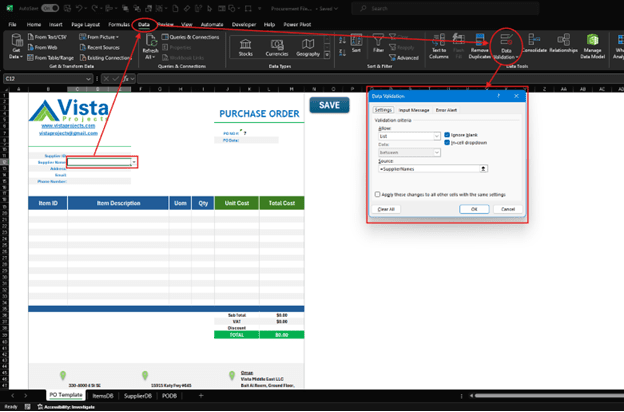
  1. Select the cell next to the “Supplier Name:” field. 
  1. On the Excel ribbon, navigate to the Data tab and in the Data Tools group, select Data Validation. 
  1. Choose the type of validation criteria (in this case list). Click inside the Source: field and press F3 on your keyboard to bring up the named ranges. Select the SupplierName and click okay. 
Picture 10 How To Apply Data Validation 
  1. Highlight the entire range of cells under the Item Description column that will be used as the PO List of items. Repeat steps 2 and 3 above and choose the ItemList named range. 

Once done, we are going to use XLOOKUP to get the rest of the supplier information and item information based on our selection. 

How to Use the XLOOKUP Function to Get Data from Tables 

The XLOOKUP Function is a powerful function that allows you to search a range or an array and returns an item that corresponds to the first match found. That is, if you have a table of 3 columns, you can search for a certain value in the first column and return it’s corresponding value in the second or third column. In our Supplier’s Table, the XLOOKUP will look for a supplier name in the Supplier Name column and return their address, phone and email address. Similarly, we will look for an item description and return its corresponding UoM, Unit Cost, and Item ID.

The XLOOKUP takes six arguments. Three arguments are required for the function to work, while the other three are optional, that is, even if you don’t include them, the function will still work.

Argument Description
lookup_value
(required)
This is the value you want to search for
lookup_array
(required)
The array/column/range to search
return_array
(required)
The array/column/range from which the corresponding value will be returned.
[if_not_found]
(optional)
Specifies what value to return if the match is not found. If omitted, Excel returns #N/A error.
[match_mode]
(optional)
Here you define whether to perform an exact match or an appropriate match. 0 – Exact Match. If none is found, return #N/A. This is the default. -1 – Exact Match. If none is found, return the next smaller item. 1 – Exact match. If none is found, return the next larger item. 2 – A wildcard match *,?, and ~ which have special meaning.
[search_mode]
(optional)
Specify the search mode to use: 1 – Perform a search starting at the first item. This is the default. -1 – Perform a reverse search starting at the last item. 2 – Perform a binary search that relies on lookup_array being sorted in ascending order. If not sorted, invalid results will be returned. -2 – Perform a binary search that relies on lookup_array being sorted in descending order. If not sorted, invalid results will be returned.

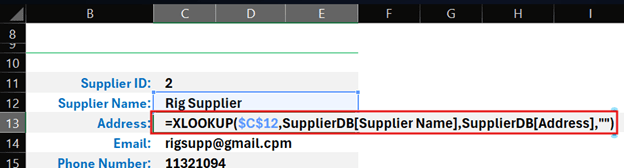
For example, in order to get the address of the supplier selected in your PO template, provided you have already registered them in your SupplierDB table, here is how the XLOOKUP would look like.

Picture 11 XLOOKUP Syntax
  • The first argument, lookup_value, is represented by whatever will be in range C12.
  • The second argument, lookup_array, is represented by, “SupplierDB[Supplier Name].” This is the syntax for referencing a table’s column inside any function/formula. The first part, “SupplierDB”, is the table name and the second part in square brackets “[Supplier Name]” is the column name.
  • The third argument, return_array, is represented by “SupplierDB[Address]”. It is the same table column reference syntax as described above.
  • Lastly, we tell the function to return an empty string, represented by two double quotes (“”), if a match is not found.

To get the other field values like email, phone, and ID, all we need to do is change the third argument(return_array) to reference the required column.

  • SupplierDB[Email] for the Email: field
  • SupplierDB[Phone] for the Phone Number: field
  • SuppierDB[Supplier ID] for Supplier ID: field

The same steps used to get the Supplier information will be used to get the items information. Check out these videos for a deeper dive into XLOOKUP.

Video Link 6 Cell Validation & XLOOKUP Part1
Video Link 6 Cell Validation & XLOOKUP Part2

Looking for project-driven supply chain management software?

Current SCM is the first of its kind – supply chain management software purpose-built to support the most complex procurement and materials management projects. With materials management and vendor document requirements uniquely integrated into the order, Current SCM provides a unified, collaborative platform to streamline the end-to-end process of project-driven procurement and materials management.

If you are engaged in any direct procurement, technical procurement, project procurement or third-party procurement, Current SCM will improve your procurement and materials management workflow. If you are engaged in all four, Current SCM will revolutionize the way you do business.

Contact our sales professionals at Current SCM today!


source https://www.vistaprojects.com/how-to-apply-data-validation-using-named-ranges/

source https://vistaprojects2.blogspot.com/2024/04/how-to-apply-data-validation-using.html

Tuesday, April 9, 2024

Hydrogen industry – optimism, challenges ahead in 2024

The clean, renewable energy age is here to stay and hydrogen is at the forefront of this revolution. The year 2024 is shaping up to be a landmark year for clean energy such as hydrogen, with significant investments, technological developments, and strategic actions driving the sector forward.

The green hydrogen industry is poised for explosive growth. A June Deloitte Center for Sustainable Progress analysis predicts it could balloon from $642 billion by 2030 to a staggering $1.4 trillion by 2050—more than double its size in just two decades!

Let’s take a closer look at what’s driving this transformation.

A Surge in Investment is Fueling Growth

hydrogen industry

One of the most notable trends in the hydrogen industry is the increased collaboration among North American countries. The United States, Canada, and Mexico are joining forces to share knowledge, resources, and best practices, driving progress and accelerating the development of hydrogen technologies.

Direct investments in North American hydrogen projects have surged to over $46 billion, up $17 billion from 2022.

In fact, Jennifer Granholm, the United States Secretary of Energy, is confident that “Clean hydrogen is a game changer. It will help decarbonize high-polluting heavy-duty and industrial sectors while delivering good-paying clean energy jobs and realizing a net-zero economy by 2050.”

1.   Policy Tailwinds

Across North America, governments are strategically implementing favorable policies to speed up the hydrogen sector’s development. These policies act as catalysts and provide a dynamic environment for investment and innovation in clean energy.

2023 witnessed a landmark shift in the U.S. clean energy landscape with the Inflation Reduction Act (IRA).  This game-changer has become a global talking point, especially for its significant impact on clean hydrogen production. The IRA throws a financial lifeline to clean hydrogen projects through tax credits. 

Most people consider this type of law a cash injection as companies can receive up to $3 per kilogram of clean hydrogen produced, depending on their carbon footprint. This incredible deal dramatically lowers production costs, making green hydrogen a more attractive competitor to traditional sources.

Hydrogen fuel and extracted clean energy are also gaining momentum outside of the United States. Canada has taken a leadership role with its Clean Hydrogen Production Tax Credit. This fiscal measure offers tax breaks to companies that invest in clean hydrogen projects.

Tax incentives range from 15% to 40% for eligible project expenditures. Projects that produce hydrogen with the lowest carbon intensity receive the most assistance. This makes clean hydrogen more economically attractive and underscores the government’s commitment to a sustainable energy future.

These collaborative efforts by North American governments pave the way for a robust hydrogen economy, fostering clean energy development and contributing to a more sustainable future.

2.   The Rise of Hydrogen Hubs

hydrogen industry

A new concept, hydrogen hubs, is also gaining traction. Think of them as a one-stop shop for all your clean hydrogen needs.

These strategically located hubs consolidate critical infrastructure elements under one roof.  Production facilities using renewable energy like solar or wind power generate clean hydrogen.  High-pressure tanks or cryogenic storage facilities ensure safe and efficient hydrogen storage.  Dedicated pipelines or innovative transportation methods like ammonia carriers facilitate long-distance transport to users.

Hydrogen hubs eliminate the need for complex, point-to-point logistics by integrating all the essential elements in one location. This reduces transportation costs, minimizes energy losses, and creates a more efficient hydrogen ecosystem.

Where Is Hydrogen Headed in North America in 2024?

The winds of change are blowing strong in the North American energy sector, and hydrogen is at the forefront of the storm. Here’s a glimpse into what’s on the horizon for hydrogen in North America in 2024:

Net-Zero Ambitions Propel Hydrogen Forward

Businesses increasingly know the need to adapt their operations to achieve net-zero emissions. Hydrogen, a clean-burning fuel, is emerging as a frontrunner in decarbonization efforts. With robust policies like the U.S. Inflation Reduction Act and potential follow-ups, North America is well-positioned to lead the global hydrogen race.

A Booming Industry on the Horizon

The North American hydrogen market is expected to be a game-changer, reaching a projected annual value of $140 billion or more by 2030.  Current capacity is around 0.53 million tons per year (mtpa), but that number is set to climb significantly, reaching an estimated 1.7 mtpa by 2030.

Blue vs. Green Hydrogen

While North America dominates blue hydrogen production (using natural gas), the focus is shifting towards green hydrogen (produced from water using renewable energy). This shift is driven by the need for truly sustainable solutions and increasing global demand for clean hydrogen.

Trends in the Hydrogen-Fueled Aviation Industry in 2024

The aviation industry is increasingly focused on reducing its carbon footprint. Sustainable Aviation Fuel (SAF), derived from renewable sources like biomass or recycled waste, are a promising solution. The year 2024 will bring greater investment in SAF production facilities and efforts to make them more cost-competitive with traditional jet fuel.

While Europe implements mandatory SAF usage in 2025, North America is also expected to see similar regulations emerge in the near future. 2024 will be a critical year for the aviation industry as it prepares for this shift towards sustainable fuel sources.

Cost Reduction and Demand Growth

Some challenges remain in the path to widespread adoption of clean hydrogen: reducing manufacturing costs and stimulating demand. Collaboration between industry, government, and academia is essential to overcome these hurdles. By working together, these groups can drive innovation in areas like hydrogen infrastructure and transportation applications, ultimately leading to a more robust market for clean hydrogen.

One of the biggest challenges facing the North American aviation industry is the need to increase production capacity to meet the rising demand for SAF. This requires partnerships and investment in new SAF production facilities.

Mexico: The Rising Star in the World of Clean Energy

While the U.S. and Canada have grabbed headlines in the North American hydrogen race, Mexico is quietly emerging as a potential game-changer. Mexico boasts some of the world’s most abundant solar and wind resources, particularly in northern states like Sonora and Tamaulipas. This natural resource provides a perfect foundation for clean hydrogen production through electrolysis powered by renewables.

Strategic locations along Mexico’s borders could become hubs for clean hydrogen production, attracting electrolysis, storage, and transportation businesses. These hubs could further strengthen North American energy security and collaboration.

Despite its promising potential, Mexico faces challenges in its quest to become a leader in clean hydrogen. For instance, building the necessary infrastructure for large-scale hydrogen production, transportation, and storage will require significant investment.  Additionally, the region requires a clear and comprehensive regulatory framework for hydrogen production, transportation, and use is needed to attract investment and ensure safety and environmental responsibility.

The Road Ahead: Challenges and Opportunities

While the future looks bright for hydrogen, there are still challenges to tackle, like safety regulations and workforce development. However, initiatives like the COP28 declaration and the U.S. Department of Energy’s Hydrogen Shot program show a commitment to overcoming these hurdles.

In conclusion, the hydrogen sector in North America is undergoing a remarkable transformation in 2024. With significant investments, technological advancements, and a focus on clean energy, the region is leading towards a more sustainable future.

Looking for a partner for your new Technology Pilot Plant?

Vista Projects is an integrated engineering services firm able to assist with your hydrogen project. With offices in Calgary, Alberta, Houston, Texas, and Muscat, Oman, we help clients tailor engineering phases for the unique needs of their projects. Contact us today!

Looking for your next (last?) great job at a great EPC firm?

Vista Projects is hiring for multiple roles in engineering and system integration – apply today!


source https://www.vistaprojects.com/hydrogen-industry-optimism-challenges-ahead-in-2024/

source https://vistaprojects2.blogspot.com/2024/04/hydrogen-industry-optimism-challenges.html

What Is Coastal Erosion Management? Causes, Strategies, and How Engineers Choose Between Them

Coastal erosion management is the structured practice of assessing, planning, and implementing strategies to slow, redirect, or adapt to lan...